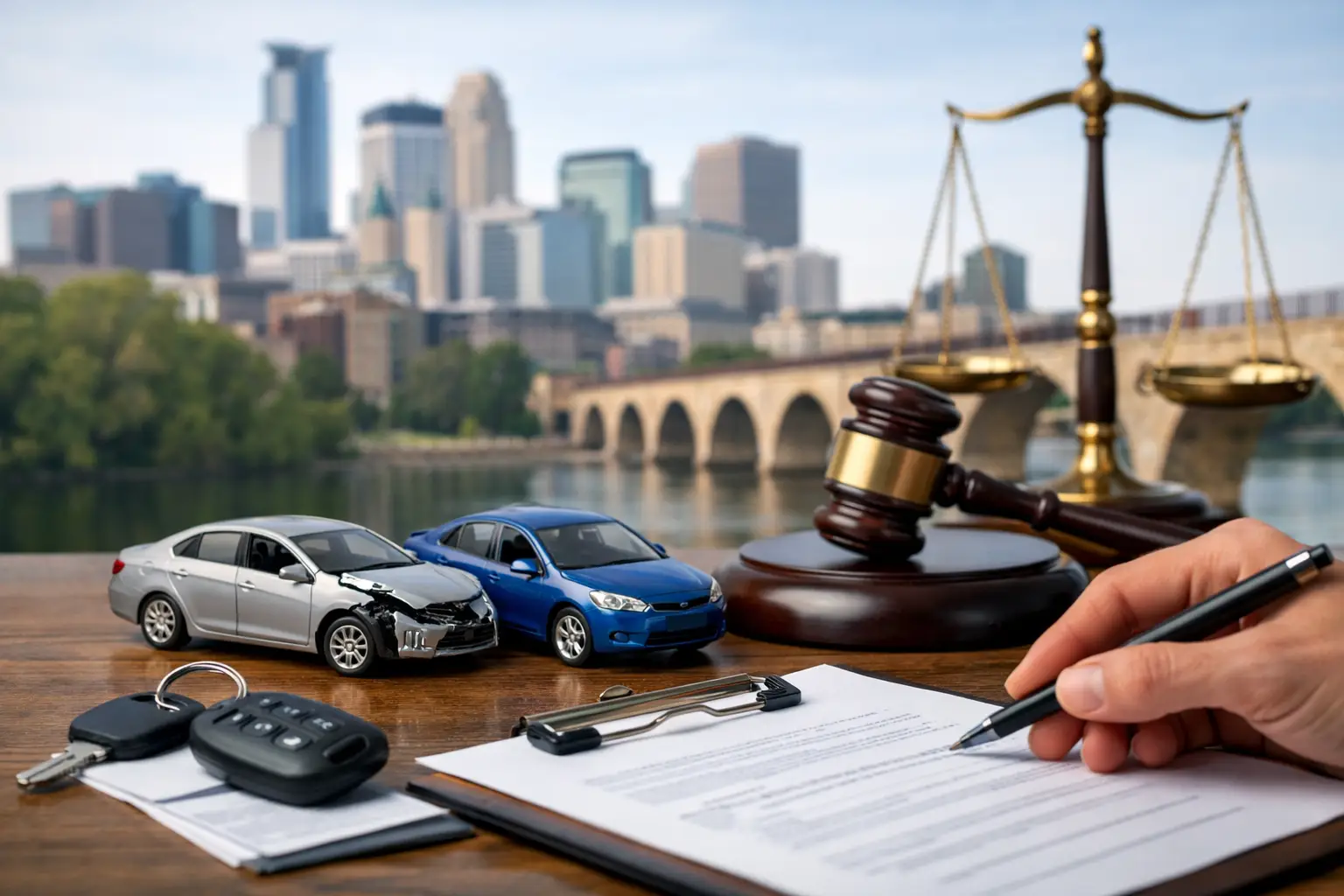
A driver runs a red light, hits your vehicle, and then you learn they have no insurance. The medical bills and missed work do not disappear simply because the at-fault driver cannot pay. This guide to uninsured motorist claims explains how Minnesota coverage may protect you, what insurers will examine, and what to do before a quick settlement costs you more than it should.
An uninsured motorist claim can be frustrating because you are usually seeking benefits from your own insurance company. You paid premiums expecting protection. Still, the insurer may closely question fault, injuries, medical treatment, available coverage, and the value of your losses. A careful approach from the beginning can make a meaningful difference.
What uninsured motorist coverage does
Uninsured motorist coverage, often called UM coverage, is meant to compensate people injured by a driver who is legally responsible for a crash but has no liability insurance. In Minnesota, automobile policies generally include this protection. It can also apply when the at-fault driver is unknown in a qualifying hit-and-run accident.
UM coverage is primarily for bodily injury losses. It is not a replacement for collision coverage that pays to repair your vehicle. Depending on the facts and policy language, a valid claim may include compensation for medical expenses, lost income, future treatment, permanent disability, pain, and the effect an injury has on your daily life.
The coverage follows a basic principle: you must prove that the uninsured driver caused the crash and that you suffered damages as a result. If the other driver was clearly at fault, that may sound straightforward. In practice, insurers often dispute one or both parts of that equation.
UM coverage is different from no-fault benefits
Minnesota is a no-fault state. After a motor vehicle accident, your own no-fault, or personal injury protection, benefits are generally the first source for certain medical expenses, wage loss, and replacement services, regardless of who caused the crash.
A UM claim is separate. It addresses damages that go beyond available no-fault benefits when an uninsured driver is responsible. It may also address losses such as pain and suffering when Minnesota’s injury threshold is met. The interaction between no-fault benefits, UM coverage, health insurance, and other available policies can be complicated. You should not assume that accepting one benefit prevents you from pursuing another, but you also cannot recover the same loss twice.
Uninsured and underinsured are not the same
An uninsured motorist claim involves a driver with no applicable liability insurance. An underinsured motorist claim involves a driver whose insurance limits are too low to fully cover the injuries they caused.
The difference matters because the available coverage, notice requirements, settlement issues, and policy language may differ. Do not let an insurer use similar terminology to rush you past a coverage question that deserves a real review.
What to do after a crash with an uninsured driver
Your health comes first. Seek medical attention promptly, follow through with recommended care, and tell your provider about every symptom you are experiencing. A gap in treatment is not always fatal to a claim, especially when injuries take time to develop, but insurers often use gaps to argue that the crash did not cause the condition or that it was not serious.
Then take practical steps to preserve the claim:
- Call law enforcement and obtain a crash report. A police report may identify the other driver, document statements, and establish whether insurance information was exchanged.
- Save evidence early. Keep photographs of the vehicles, scene, injuries, damaged property, and any visible skid marks or debris. Preserve witness names, phone numbers, video, and communications with the other driver.
- Notify your insurer promptly. Tell the company that the other driver appears uninsured and ask how to open both a no-fault claim and a UM claim if appropriate. Prompt notice is important, but avoid speculating about fault or the extent of your injuries.
- Keep records of the financial impact. Save medical bills, pharmacy receipts, mileage to appointments, wage-loss information, work restrictions, and notes about activities you can no longer do normally.
- Be careful with recorded statements and releases. An insurer may request a statement or medical authorization early in the process. Cooperation may be required, but a broad release or an imprecise statement can create problems later.
Hit-and-run accidents need fast action
A hit-and-run crash can create an uninsured motorist claim, but it often presents additional proof issues. The insurer may question whether an unidentified vehicle was actually involved, whether physical contact occurred, and whether there is independent evidence supporting your account.
Report the collision immediately. If witnesses saw the vehicle, obtain their information before memories fade. Ask nearby businesses, homeowners, or public agencies about available camera footage as soon as possible because many systems overwrite recordings quickly. Photographs of damage and the crash scene can also help explain how the incident happened.
Minnesota law and policy terms can be demanding in claims involving an unidentified vehicle. Physical contact is often a central issue. A driver who swerves to avoid a “phantom” vehicle may face a harder claim than someone whose vehicle was struck by a hit-and-run driver. The details matter, including whether a chain-reaction collision occurred and what evidence supports the event.
How insurers evaluate uninsured motorist claims
Even when the other driver has no insurance, your insurer is not required to accept every claimed loss without review. The company may investigate the crash, examine your medical history, request records, and compare your treatment to the force of impact and property damage.
It may argue that you were partly responsible for the collision. Minnesota’s comparative fault rules can reduce recovery when an injured person shares fault. It may also claim that an injury was preexisting, unrelated to the crash, or resolved sooner than your doctors believe. These arguments are common, particularly with neck, back, shoulder, concussion, and soft-tissue injuries that may not appear clearly on an initial scan.
That does not mean a prior condition defeats your claim. A crash can aggravate an existing condition, and the responsible party may still be liable for the harm caused by that aggravation. Clear medical records and a consistent account of your symptoms are critical.
Find every policy that may apply
The policy on the vehicle you occupied is often the starting point, but it may not be the only policy. Coverage can depend on whether you were driving your own vehicle, riding as a passenger, borrowing a car, biking, walking, or living with a relative who has auto insurance.
There may be questions about resident-relative coverage, coverage on multiple vehicles, policy limits, and whether coverage can be combined in a particular situation. Insurers do not always volunteer the most favorable interpretation. A complete policy review should occur before you agree to settle.
Do not settle before your injuries are understood
Early settlement offers can be tempting when bills are arriving and you are missing work. But a settlement usually ends the claim permanently. If you accept payment before you know whether you need future treatment, surgery, therapy, or extended work restrictions, there may be no second opportunity to recover for those losses.
This does not mean every UM claim should be pushed into litigation. Some claims can be resolved fairly through well-supported negotiations. Others require arbitration or a lawsuit because the insurer refuses to recognize fault, coverage, or the true extent of an injury. The right path depends on the evidence, the policy, the severity of the injuries, and the insurer’s conduct.
A realistic case evaluation should account for both the strengths and the risks. Strong advocacy is not making inflated promises. It is building the proof, identifying available insurance, challenging unfair arguments, and being prepared to take the next step when a reasonable offer is not made.
When it makes sense to speak with an attorney
You should consider legal help when injuries are significant, the crash involved a hit-and-run driver, fault is disputed, the insurer delays or denies coverage, or an offer does not reflect the impact of the accident. These cases can involve deadlines, policy conditions, medical evidence, and overlapping benefits that are difficult to manage while you are trying to recover.
The Law Office of Martin T. Montilino represents injured people in Minneapolis and throughout the Twin Cities with direct, attorney-led guidance. A careful review can clarify what coverage exists, what documentation is needed, and whether the insurer is treating your claim fairly.
The most useful next step is often simple: protect the evidence, continue appropriate medical care, and get clear answers before signing away your rights. An uninsured driver should not leave you carrying the financial burden of a crash you did not cause.