
A vehicle strikes your car, and before you can identify the driver, it disappears into Minneapolis traffic. You may be left with injuries, vehicle damage, and no obvious person to hold responsible. What rights does an injured driver have after Minnesota hit-and-run accidents?
An unidentified driver does not automatically eliminate every possible source of compensation. Reporting the crash promptly, preserving evidence, notifying insurers, and investigating available coverage can all matter. A Minneapolis hit-and-run accident claim may involve more than a traditional liability claim against a known driver.
Martin Montilino helps injured people understand the insurance and evidence issues that can arise after serious crashes. This article explains a calm, practical checklist for Minneapolis drivers: what to do at the scene, how to preserve proof, how Minnesota no-fault benefits may help, and why uninsured-motorist coverage may become important.
Minnesota Hit-and-Run Accident Lawyer Minneapolis: What Rights Does an Injured Driver Have?
A hit-and-run crash can create two separate questions. First, can the responsible vehicle or driver be identified? Second, if identification is not possible, what insurance benefits or claims may still be available?
Report the crash and document what you know
If anyone may be injured or the roadway is unsafe, calling 911 can help initiate emergency response and law-enforcement reporting. In Minneapolis, the responding agency may depend on where the collision occurred, such as a city street, county road, or highway. A report can document the time, location, vehicle movements, damage, and witness information while those details are still fresh.
When speaking with an officer or insurer, provide facts rather than guesses. Useful details may include:
- The direction the other vehicle traveled
- A partial license-plate number, if remembered
- Make, model, color, body style, or distinctive damage
- The location and lane of impact
- Names and contact information for witnesses
- Nearby businesses, residences, transit stops, or traffic cameras
Do not follow a fleeing vehicle or place yourself in danger. If you can safely do so, photograph the scene, vehicle damage, road conditions, debris, and visible injuries. Keep copies of the report number, photographs, videos, medical records, and insurance communications.
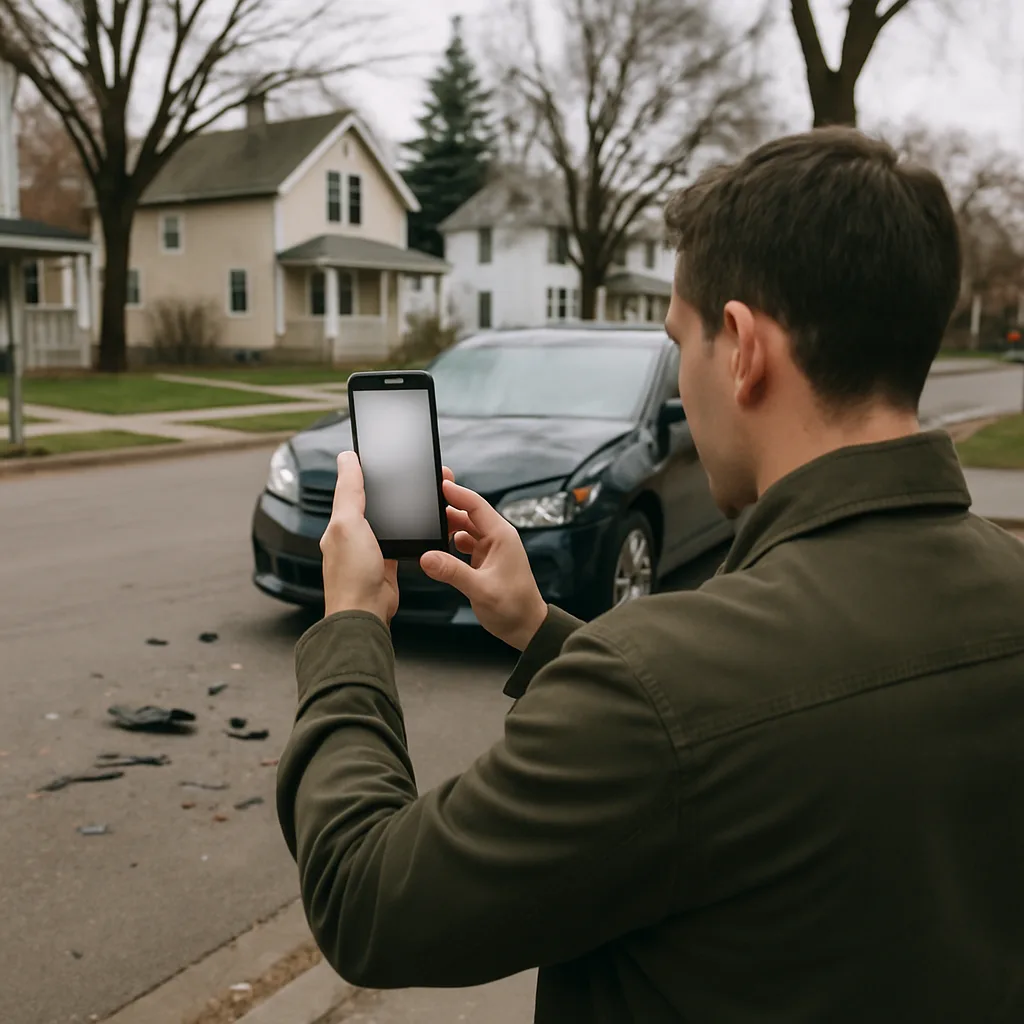
Preserve hit-and-run evidence before it disappears
Evidence is often especially important when there is no identified driver’s statement or insurance information. Physical damage, paint transfer, debris, witness accounts, and digital footage may help establish how the collision occurred and narrow the search for the other vehicle.
Identify witnesses and surveillance quickly
Ask witnesses whether they saw the vehicle, its direction of travel, or the impact. Obtain permission to record their contact details accurately. Nearby stores, apartment buildings, parking facilities, gas stations, and transportation facilities may have security cameras. Footage may be overwritten or retained for only a limited period, so an attorney may advise sending a preservation request or taking other steps promptly.
Traffic-camera footage is not guaranteed to exist or to show the collision clearly. Still, identifying the intersection, time window, and likely camera locations can help an investigation. A description such as “dark SUV” may be less useful than a detailed account of body style, visible damage, stickers, wheels, headlights, or travel direction.
For additional guidance on photographs, medical documentation, witness information, and other proof, review the strongest evidence for an injury claim. Medical records can also connect treatment to the crash, although only a qualified medical professional can assess an injury or treatment plan.
Insurance options after a Minnesota hit-and-run crash
When the other driver cannot be identified, the insurance strategy may differ from an ordinary negligence claim. Minnesota’s no-fault system may provide certain benefits regardless of who caused the crash, while uninsured-motorist coverage may offer another potential avenue when the responsible driver is unidentified. Eligibility, limits, exclusions, notice requirements, and proof issues depend on the policy and the facts.
Consider no-fault benefits while the investigation continues
Depending on the circumstances, an injured person may be eligible to seek Minnesota no-fault benefits for covered accident-related medical expenses and certain wage losses. These benefits are separate from a claim based on the other driver’s fault. They may help address immediate financial pressure while police, insurers, witnesses, or an attorney investigate the unidentified vehicle.
A person should generally notify the relevant insurer and review policy requirements carefully. Delays, incomplete information, or assumptions about which policy applies can create complications. Minnesota no-fault benefits for medical bills and lost wages provides more background on this distinct coverage.
Investigate uninsured-motorist coverage
An unidentified hit-and-run driver may be treated as an uninsured motorist for coverage purposes, but that does not mean every claim is automatically approved. The policy may require prompt notice, cooperation with an investigation, proof of physical contact in some circumstances, or other conditions. The injured person’s own policy, a household policy, or another potentially applicable policy may need review.
Insurers may also investigate whether the crash happened as reported, whether the vehicle can be identified, and whether the injuries are related to the collision. An attorney may help evaluate coverage language and communications without promising that coverage or compensation will be available.
Avoid common mistakes and protect potential claim deadlines
The first days after a hit-and-run can affect both evidence and insurance claims. Common problems include waiting too long to report the crash, failing to obtain medical documentation, discarding damaged property before it is photographed, or giving an insurer an incomplete account because important details were forgotten.
A practical checklist includes:
- Report the collision to the appropriate law-enforcement agency and obtain available report information.
- Seek medical evaluation when appropriate and keep records of appointments, bills, restrictions, and missed work.
- Notify potentially relevant insurers according to the policy and preserve letters, emails, recorded statements, and claim numbers.
- Write down everything remembered about the vehicle, roadway, impact, witnesses, and nearby cameras.
- Avoid posting detailed crash commentary or photographs that could be misunderstood outside their context.
- Obtain legal guidance early enough to assess coverage, evidence preservation, and deadlines.
Minnesota deadlines can vary depending on the type of claim, the parties involved, and the insurance policy. Because investigation takes time, do not assume that an unresolved police investigation pauses every legal or contractual deadline. See Minnesota car accident claim deadlines for general background, and consider discussing the specific circumstances with a licensed Minnesota attorney.
Frequently Asked Questions
Can I pursue compensation if the hit-and-run driver is never found?
Possibly. An injured person may have access to Minnesota no-fault benefits and, depending on the policy and facts, may be able to pursue an uninsured-motorist claim. The availability and value of any claim can depend on proof of the crash, the injuries, policy language, notice requirements, and applicable deadlines. A police report and prompt evidence preservation may support the insurance investigation, but they do not guarantee coverage.
What if I only remember part of the other vehicle’s license plate?
Report the partial plate and every other detail you remember, including color, make, model, body style, direction of travel, and visible damage. Avoid filling gaps with guesses. A partial plate may be useful when combined with witness accounts, surveillance footage, and location information. Law enforcement and insurers may determine what follow-up is possible. Preserving your own photographs and notes can help keep the description consistent.
Does a hit-and-run affect my Minnesota no-fault benefits?
The driver’s disappearance does not necessarily prevent an injured person from seeking potentially available no-fault benefits. Minnesota no-fault coverage and uninsured-motorist coverage serve different purposes, and eligibility depends on the facts and applicable policy. No-fault benefits may address certain medical expenses and wage losses, while uninsured-motorist coverage may involve injury claims connected to an unidentified vehicle. Prompt notice and accurate documentation are generally important.
Should I speak with an attorney before accepting an insurance payment?
Depending on the circumstances, an attorney may advise reviewing the proposed payment, release language, policy terms, and other available coverage before accepting an offer. A payment may address one category of benefits without resolving every potential issue. Legal advice can be especially useful when the driver is unidentified, injuries are ongoing, multiple policies may apply, or a deadline could affect the claim.
How Martin Montilino Can Help
Martin Montilino is dedicated to helping injured Minneapolis-area drivers understand their rights after hit-and-run crashes. The firm can evaluate the available evidence, help identify questions about no-fault and uninsured-motorist coverage, and explain how witness information, photographs, medical records, and surveillance footage may affect an injury claim.
Every collision is different, and no attorney can promise a particular result. The firm is committed to fighting for clients’ rights while providing clear information about legal and insurance options. Contact Martin Montilino for a free consultation or case evaluation to discuss what happened and what options may be available.
The information in this article is for educational purposes only and does not constitute legal advice. Contact a qualified attorney licensed in Minneapolis, mn for advice specific to your situation.