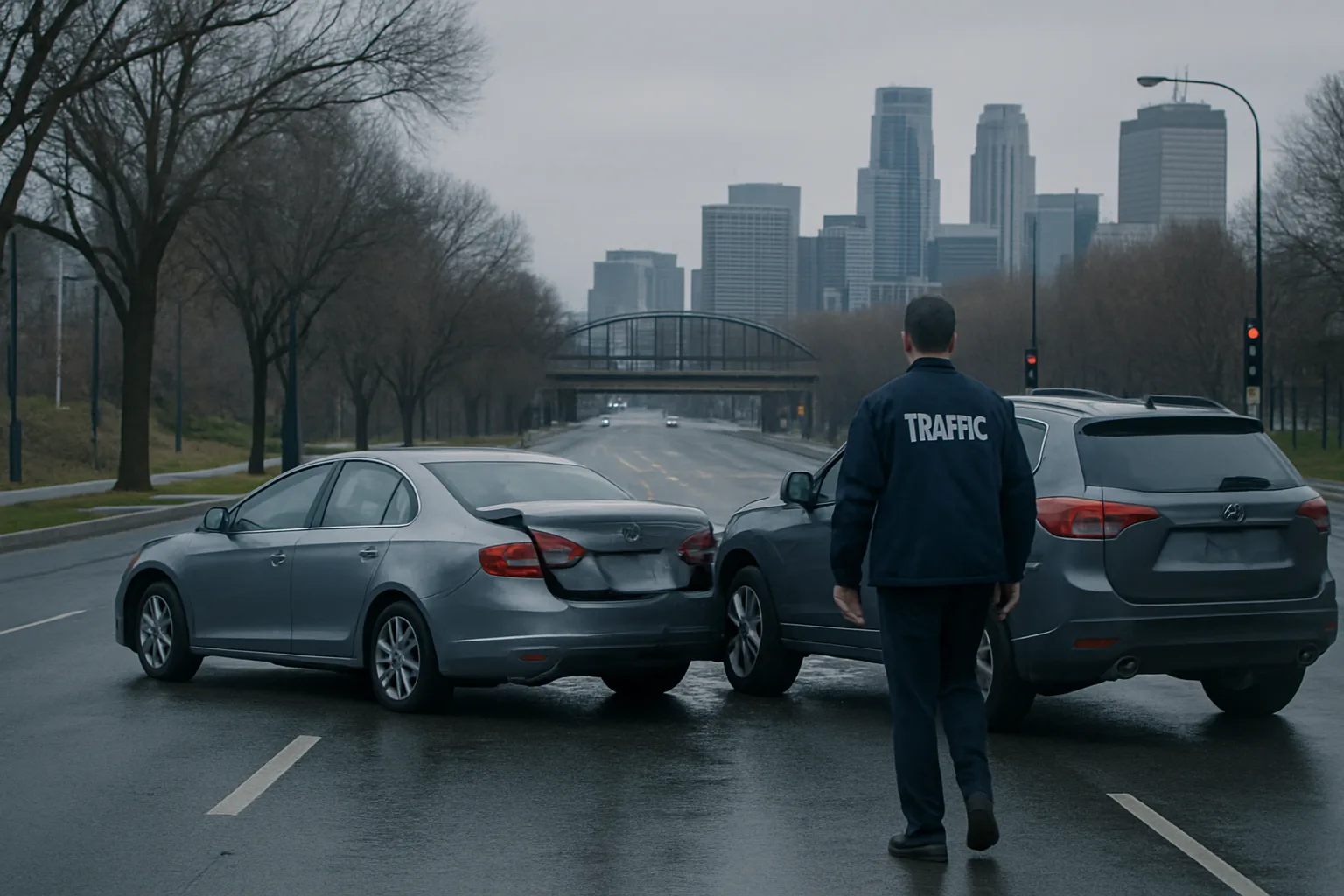
A crash involving two vehicles can be difficult enough to understand. When one car changes lanes, another is speeding, and a third vehicle cannot stop in time, determining responsibility becomes more complicated. Who may be responsible when two drivers cause a Minneapolis crash? The answer may depend on what each driver did, how those actions contributed to the collision, and what the available evidence shows.
Multiple driver car accident liability in Minnesota is not always an all-or-nothing question. Two or more drivers may share responsibility for different parts of the same event. Martin Montilino helps injured people understand the issues that can affect a claim, including causation, insurance coverage, evidence, and comparative fault. This article explains how those issues may work in Minneapolis, what evidence can matter, and why an early assumption about fault may be incomplete.
How Is Multiple Driver Car Accident Liability Determined in Minnesota?
In a multi-vehicle crash, responsibility generally turns on two related questions: Did a driver act negligently, and did that conduct contribute to the injuries or property damage? A driver may be considered negligent when the driver fails to use reasonable care under the circumstances. Examples can include unsafe lane changes, following too closely, speeding, distracted driving, or failing to respond to a developing hazard.
Chain reactions and separate contributions
Consider a hypothetical chain reaction on a Minneapolis roadway. Driver A changes lanes without enough clearance and causes Driver B to swerve. Driver B, who may also be traveling too fast, strikes Driver C. Driver C then hits another vehicle after delayed braking. The first lane change may have started the sequence, but later conduct could also have increased the severity of the crash.
That does not automatically make every driver equally responsible. The legal analysis may ask whether each act was a substantial factor in causing a particular collision or injury. A driver who caused the initial impact may not be responsible for every later consequence if another independent event broke the chain of causation. These questions are fact-specific.
Why the first impact does not always settle fault
Police reports, vehicle positions, and witness accounts can help explain the sequence, but an initial report may not resolve every civil liability question. Damage patterns, event data, traffic-camera footage, phone records, photographs, and testimony may provide additional context. In Minneapolis, roadway design, weather, traffic flow, and visibility may also help explain why a driver had limited time to react.
What Evidence Matters in Shared-Fault Car Accident Claims?
Evidence should help establish what happened, who contributed to it, and how the collision caused a person’s claimed losses. In a shared fault car accident in Minneapolis, evidence may point to more than one contributing driver. It may also show that a driver accused of causing the crash did not have enough time or opportunity to avoid it.
- Photos and videos of vehicle damage, debris, lane positions, traffic signals, and road conditions.
- Dashcam, surveillance, or traffic-camera footage, when available and legally obtainable.
- Names and contact information for witnesses.
- The police crash report and records from emergency responders.
- Vehicle event-data information, when a vehicle stores relevant pre-crash data.
- Cellphone or application records when distraction is reasonably suspected and the records are available through proper procedures.
- Medical records and other documentation connecting the injuries to the collision.
- Repair estimates, employment records, and other materials documenting economic losses.
Minnesota drivers and passengers may also deal with the state’s no-fault insurance system. No-fault benefits may address certain medical expenses and wage losses regardless of who caused the crash, subject to policy terms and legal requirements. Those benefits are separate from a possible liability claim against a negligent driver. Because coverage and eligibility can depend on the circumstances, an attorney may review the applicable policies and facts.
In Minneapolis cases, records may come from multiple sources, including law enforcement, insurance carriers, medical providers, employers, and businesses that maintain security footage. Some evidence is retained only for a limited period. That makes prompt preservation and collection important, although the appropriate process depends on the evidence and the parties involved.
How Can Comparative Fault Affect a Minnesota Multi-Vehicle Crash Claim?
Minnesota generally follows a comparative fault approach when more than one person contributed to an accident. A fact finder may assign percentages of fault to the injured person, one or more drivers, and potentially other responsible parties if the evidence supports their involvement. The allocation may affect how much can be recovered on a negligence claim.
For example, an injured passenger might claim that Driver A made an unsafe lane change and Driver B was speeding. If evidence supports fault by both drivers, the claim may involve allegations against both rather than focusing only on the first vehicle involved. The percentages are not determined by the number of impacts alone. They depend on the evidence and the relationship between each person’s conduct and the claimed harm.
Common mistakes after a multi-vehicle collision
- Assuming the driver who hit another vehicle from behind is automatically the only responsible party.
- Giving a recorded statement before understanding the complete sequence of impacts.
- Failing to identify witnesses or request preservation of video evidence.
- Treating an insurance company’s early assessment as a final determination of legal fault.
- Posting photos or comments online that omit important context about the crash or injuries.
- Waiting to obtain legal guidance until evidence has been lost or memories have changed.
A person does not necessarily need to determine fault at the roadside. It is generally useful to exchange information, cooperate with required reporting, obtain appropriate medical attention, and preserve available records. Depending on the circumstances, a lawyer may help organize evidence and evaluate whether claims should be presented to one or more insurers or parties.
Minnesota deadlines and procedural requirements can affect injury claims. Laws vary by jurisdiction and may change since publication, so a person involved in a Minneapolis crash may benefit from discussing timing and claim options with a Minnesota-licensed attorney.
Frequently Asked Questions
Can I make a claim against more than one driver after a Minneapolis crash?
Possibly. If evidence indicates that two or more drivers contributed to the collision or resulting injuries, an injured person may have claims involving multiple parties. Each claim still requires support for negligence, causation, and damages. Insurance policies, available coverage, and Minnesota comparative fault rules may affect the process. A qualified attorney can evaluate the facts and identify potentially responsible parties without assuming that every driver shares equal fault.
Does a rear driver always pay for a chain-reaction accident?
No. A rear driver may have contributed by following too closely, speeding, or failing to brake, but another driver’s unsafe lane change or sudden movement may also have helped cause the sequence. The facts may show that one driver caused the initial impact while another increased the severity of later impacts. Responsibility depends on evidence about timing, distance, speed, visibility, and each driver’s opportunity to avoid the collision.
Can passengers recover when multiple drivers caused the crash?
A passenger who was injured may have rights that differ from those of the drivers. Depending on the facts, the passenger may seek no-fault benefits and may also consider a liability claim against one or more negligent drivers. The passenger’s own conduct is not usually analyzed in the same way as a driver’s conduct, but the applicable insurance and comparative fault issues can be complex. Policy language and Minnesota law should be reviewed carefully.
What if the drivers disagree about how the crash happened?
Disagreement does not by itself determine the outcome. Investigators, insurers, and courts may consider physical evidence, photographs, vehicle damage, witness accounts, video, roadway conditions, and data from the vehicles. In some cases, accident reconstruction or other expert analysis may be relevant. An injured person generally should avoid guessing about disputed details and may want legal guidance before making statements that could be taken out of context.
How Martin Montilino Can Help
Martin Montilino is dedicated to helping injured people understand the issues that may arise after a multi-vehicle collision. The firm can review the sequence of impacts, available photographs and reports, insurance information, medical documentation, and other evidence relevant to causation and comparative fault.
The team is committed to fighting for clients’ rights while providing a clear assessment of potential options. If you were hurt in a Minneapolis, mn crash involving two or more drivers, Martin Montilino is ready to evaluate your situation. Contact the firm to request a free consultation or case evaluation and discuss your circumstances with a legal professional.
The information in this article is for educational purposes only and does not constitute legal advice. Contact a qualified attorney licensed in Minneapolis, mn for advice specific to your situation.